
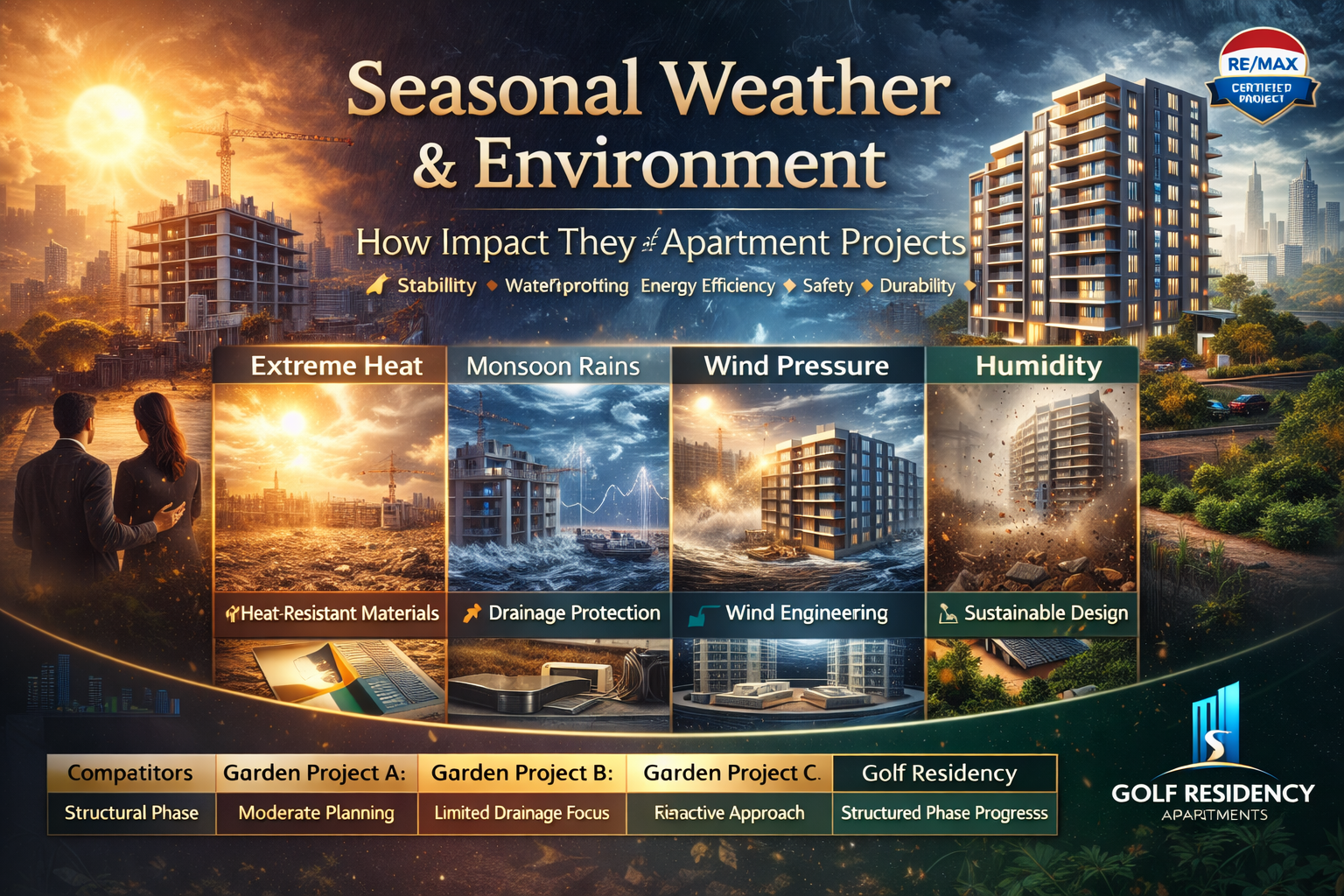
The Invisible Hand That Shapes Every Construction Timeline
Every investor tracking their apartment’s progress has felt frustration when deadlines slip. Often, the blame falls on developers. But there is an invisible force that shapes construction timelines everywhere—from Toronto to Tokyo, from London to Lahore.
Weather and environment.
Rain, heat, cold, wind, and natural site conditions pause construction with the same certainty as any regulatory delay. Understanding these forces is essential to setting realistic expectations and evaluating developer responsiveness.
This blog reveals how seasonal and environmental factors impact high-rise construction globally—and what Phase 7 investors need to know.
🌍 Part 1: The Global Reality — Weather Delays Are Universal
🇨🇦 Canada: Winter Shutdowns
| Factor | Impact |
|---|---|
| Winter temperatures | Concrete curing stops below -5°C |
| Snow accumulation | Site access blocked, safety risks |
| Frozen ground | Excavation impossible |
| Daylight hours | Reduced working time |
Typical Delay: 3-5 months annually. Projects in Toronto routinely build in winter shutdown buffers of 4-6 weeks minimum .
🇬🇧 United Kingdom: Rain and Wind
| Factor | Impact |
|---|---|
| Rainfall (150+ days/year) | Earthworks halted, safety risks |
| High winds | Crane operations suspended above certain speeds |
| Fog | Reduced visibility for precision work |
Typical Delay: UK construction projects lose an average of 20-30 working days per year to adverse weather .
🇺🇸 United States: Regional Extremes
| Region | Weather Challenge | Impact |
|---|---|---|
| Northeast | Winter storms, snow | 2-4 months delay potential |
| Southeast | Hurricanes, lightning | Evacuations, site shutdowns |
| Midwest | Tornadoes, extreme cold | Unpredictable stoppages |
| Southwest | Extreme heat | Reduced worker productivity, concrete issues |
Typical Delay: 15-25% of scheduled time lost to weather annually across major markets .
🇦🇪 Dubai: Heat and Fog
| Factor | Impact |
|---|---|
| Summer temperatures (45-50°C) | Afternoon work bans (12-3pm) |
| High humidity | Concrete curing challenges |
| Winter fog | Reduced visibility, delayed material delivery |
Typical Delay: Projects in Dubai factor in 2-3 months of weather-related slowdowns annually .
🌱 Part 2: The Local Reality — Islamabad/Rawalpindi Weather Patterns
Islamabad’s Four Distinct Seasons
| Season | Months | Construction Impact |
|---|---|---|
| Spring | March-April | Ideal conditions. Peak construction window. |
| Summer | May-June | Heat affects worker productivity. Concrete curing requires extra water. |
| Monsoon | July-September | HIGHEST IMPACT. Heavy rains halt excavation, delay material delivery, risk flooding. |
| Autumn | October-November | Ideal conditions. Second peak construction window. |
| Winter | December-February | Fog reduces visibility. Cold slows concrete curing. Occasional rain. |
Detailed Impact Analysis
☔ Monsoon Rains (July-September)
| Construction Activity | Impact |
|---|---|
| Excavation | Halted completely — mud, safety risks |
| Foundation work | Delayed — water in trenches |
| Material delivery | Slowed — access roads affected |
| Concrete pouring | Quality risk if rain occurs during curing |
| External finishing | Cannot proceed in wet conditions |
Typical Annual Delay: 4-8 weeks lost during monsoon season.
🌫️ Winter Fog (December-January)
| Construction Activity | Impact |
|---|---|
| Crane operations | Reduced visibility = slower work |
| Material transport | Highway delays, late deliveries |
| Concrete curing | Slower in cold temperatures |
| Worker productivity | Reduced due to cold and shorter daylight |
Typical Annual Delay: 2-4 weeks lost during peak fog.
☀️ Summer Heat (May-June)
| Construction Activity | Impact |
|---|---|
| Worker productivity | Reduced — need frequent breaks |
| Concrete curing | Requires extra water, careful monitoring |
| Afternoon work | Slows during peak heat hours |
Typical Annual Delay: 1-2 weeks cumulative productivity loss.
📊 Part 3: Phase 7 Project Progress — Weather Impact Assessment
| Project | Current Stage | Weather Vulnerability | Status |
|---|---|---|---|
| Golf Residency | Retaining Wall COMPLETE Raft Foundation IN PROGRESS | ✅ Foundation stage ongoing — can continue through most weather with planning | 🟢 LOW |
| Golf Floras | Land Leveling / Marketing | ⚠️ Site preparation — highly vulnerable to monsoon | 🟡 MEDIUM |
| Golf Floras II | Early Stages / Marketing | ⚠️ Early site work — highly vulnerable to rain | 🟡 MEDIUM |
| Khayal / IOXORA | Land Preparation / Marketing | ⚠️ Earthworks — stopped by heavy rain | 🟡 MEDIUM |
| Golf Vista | Marketing Only | ❌ No construction visible — weather impact not applicable | 🔴 HIGH |
| Aeterius One | Marketing Only | ❌ No construction visible | 🔴 HIGH |
| Zem Gardenia | Marketing Only | ❌ No construction visible | 🔴 HIGH |
Why Golf Residency’s Stage Matters for Weather Resilience
| Construction Phase | Weather Vulnerability | Golf Residency Status |
|---|---|---|
| Land Leveling | 🔴 EXTREME — rain stops all work | ✅ COMPLETE |
| Excavation | 🔴 HIGH — water in trenches | ✅ COMPLETE |
| Retaining Wall | 🟡 MEDIUM — can proceed with planning | ✅ COMPLETE |
| Foundation | 🟡 MEDIUM — concrete requires weather management | ✅ IN PROGRESS |
| Superstructure | 🟢 LOW — vertical work less affected | ⏳ Upcoming |
| Finishing | 🟡 MEDIUM — external work weather-sensitive | ⏳ Upcoming |
The Insight: Golf Residency has already passed the most weather-vulnerable phases. This is a significant competitive advantage.
🧠 Part 4: Smart Developers Build Weather Buffers
Global Best Practices
| Practice | Description | Example |
|---|---|---|
| Weather modeling | Use historical data to predict delays | Toronto: 4-6 week winter buffer |
| Phased scheduling | Schedule earthworks outside monsoon | UAE: Finish foundations before summer |
| Concrete additives | Accelerators for cold, retarders for heat | Global standard |
| Temporary shelters | Allow work to continue in light rain | Used in UK, Europe |
| Indoor prefabrication | Build components off-site | Dubai, Singapore |
Golf Residency’s Approach
| Weather Challenge | Mitigation Strategy | Status |
|---|---|---|
| Monsoon rains | Foundation work scheduled to minimize exposure | ✅ In progress before peak rain |
| Winter fog | Vertical construction planned for clearer months | ⏳ Upcoming |
| Summer heat | Morning/evening work shifts | ✅ Active workforce planning |
📈 Part 5: What This Means for Your Investment
If You Are Invested in Golf Residency
| Concern | Reality |
|---|---|
| “Will weather delay possession further?” | ✅ Highest-risk phases (land prep, excavation) are complete. Remaining work is less weather-sensitive. |
| “Is the developer planning for weather?” | ✅ Foundation scheduled to minimize monsoon impact. Active workforce visible. |
| “Should I worry about future delays?” | 🟢 Low risk — project has passed most vulnerable stages. |
If You Are Considering Investment
| Question | Why Ask | Golf Residency’s Answer |
|---|---|---|
| Has the project passed weather-vulnerable phases? | Land prep and excavation are most affected | ✅ YES — retaining wall complete |
| Is construction visible during current season? | Shows developer is working despite weather | ✅ YES — active workforce |
| Does the developer have a weather strategy? | Indicates professional management | ✅ Transparent about planning |
🌟 The Bottom Line: Weather Is Unavoidable — Response Is Not
Across the globe, weather shapes construction timelines:
| Market | Annual Weather Delay |
|---|---|
| Toronto, Canada | 3-5 months |
| London, UK | 20-30 working days |
| New York, USA | 15-25% of schedule |
| Dubai, UAE | 2-3 months factored in |
| Islamabad, Pakistan | 6-10 weeks typical |
The question is not whether weather will cause delays. It will.
The question is: Which projects have planned for it?
Golf Residency has passed the most weather-vulnerable phases. Our retaining wall is complete. Our foundation is in progress. The hardest part—the part most affected by rain, heat, and cold—is behind us.
